Want Your business to Thrive?
Stay connected with our weekly newsletter that contains tips and actionable advice you can use.
- Aug 21, 2024
Episode #68 – Essential Financial Metrics Every Solo and Small Law Firm Should Track
As a reminder, I am a guest speaker for a webinar series hosted by MyCase, LawPay, CasePEER, and Affinipay. We will cover several topics that center around financial wellness for law firms. You won’t want to miss this! The 4th and last webinar is today. If you can’t make it live, the recording will be sent out to everyone who registers. And all 4 of the recordings will be made available to everyone who registers for any one of the sessions. Click HERE to register now.
In our last episode, we discussed insightful feedback from a webinar attendee who felt that managing business finances and tracking KPIs seemed overwhelming and unnecessary for a one-person law firm. This got me thinking about the importance of financial management, regardless of the size of your practice. Whether you’re a solo practitioner or part of a larger firm, understanding and monitoring your financial health is crucial for sustainability, profitability, and growth.
Today, I want to offer the top KPIs that every solo law firm should monitor for financial success. I’ll explain how to use each one, what a good result looks like, and offer ways to improve each metric. By the end of this episode, you’ll have a clear roadmap to start implementing these KPIs in your practice.
Before we dive into the specifics, it’s important to note that you don’t need to track all 10 of these KPIs. In fact, trying to monitor too many metrics can be overwhelming and counterproductive. Instead, I recommend starting with 3-5 KPIs that are most relevant to your practice. I’m offering 10 KPIs because for some of these KPIs you may not have the data readily available to you. Also, it’s essential to choose the ones that provide the most valuable insights for your firm.
Be sure to review your KPIs on a monthly or quarterly basis. Focus on the trend of your performance. While I’m going to include target numbers for some KPIs, remember what I mentioned in the last episode – your goal is to do better than you did the last time you looked at your KPIs.
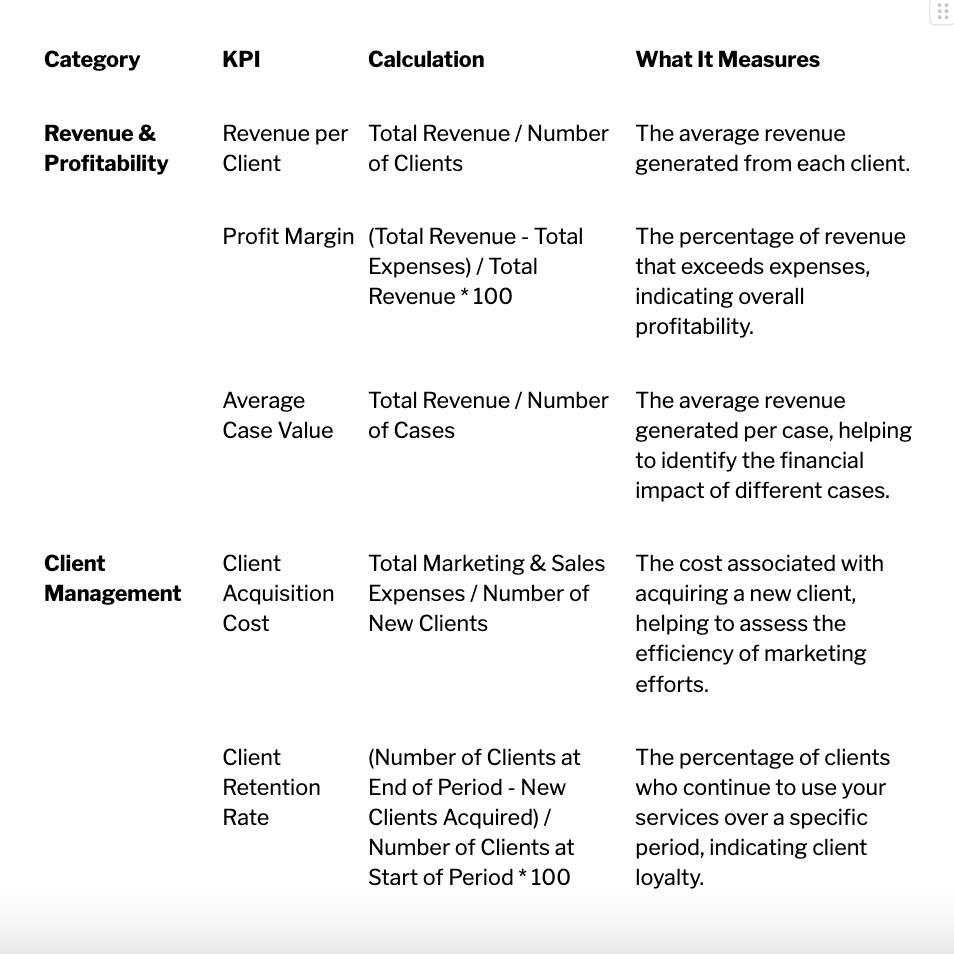
Revenue per Client
This KPI measures the average revenue generated from each client. To calculate it, divide your total revenue by the number of clients. A good result here depends on your specific goals, but generally, higher revenue per client indicates better financial health. To improve this metric, consider offering additional services to your current clients or increasing your rates if justified by the value you provide.
Profit Margin
This KPI shows the percentage of revenue that exceeds your expenses. Calculate it by subtracting your total expenses from your total revenue, then dividing by total revenue and multiplying by 100. A healthy profit margin varies by industry but aiming for at least 20% is a good start. To improve your profit margin, focus on reducing unnecessary expenses and increasing your revenue streams.
Average Case Value
This measures the average revenue generated per case. Calculate it by dividing your total revenue by the number of cases. A higher average case value indicates more profitable cases. To improve this metric, target higher-value cases or increase your fees for complex cases.
Client Acquisition Cost (CAC)
This KPI calculates the cost associated with acquiring a new client. Divide your total marketing and sales expenses by the number of new clients. A lower CAC is better, as it means you’re acquiring clients more efficiently. To reduce CAC, optimize your marketing strategies and focus on referral programs.
Client Retention Rate
This KPI tracks the percentage of clients who continue to use your services over a specific period. Calculate it by subtracting the number of new clients acquired from the number of clients at the end of the period, then dividing by the number of clients at the start of the period and multiplying by 100. A high retention rate, ideally above 80%, indicates strong client loyalty. To improve retention, focus on providing excellent service and maintaining regular communication with clients.
Client Satisfaction Score
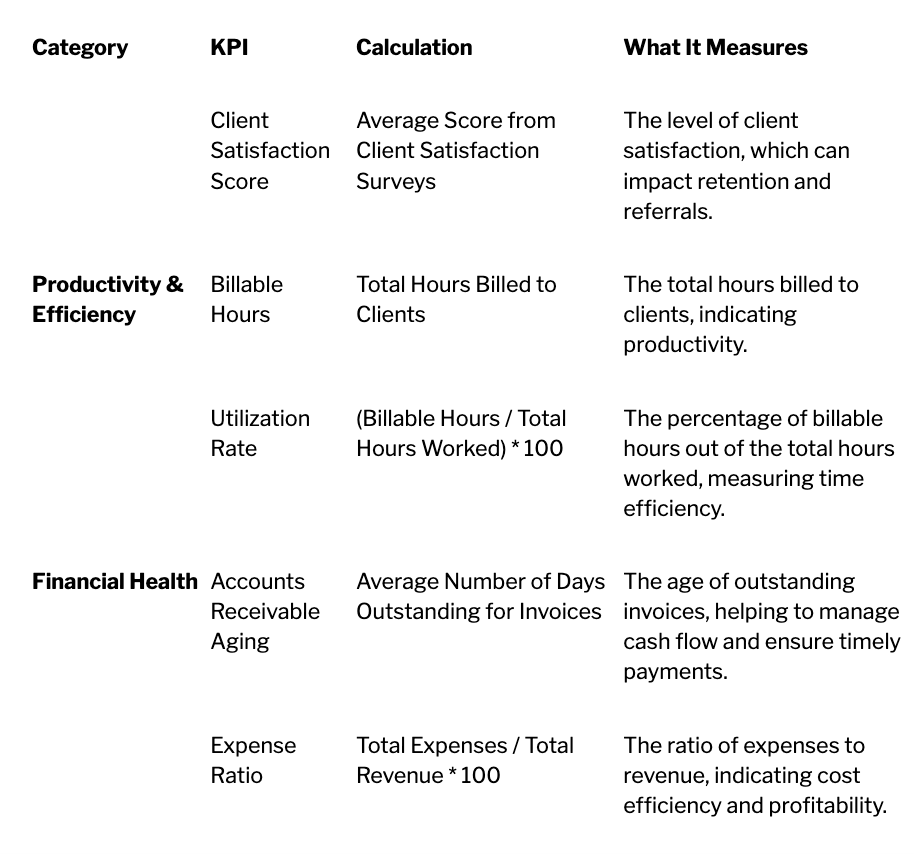
Client Satisfaction Score measures the level of client satisfaction through surveys or feedback forms. I like this one, but I realize that sometimes it is hard for a smaller firm to conduct client surveys. Calculate the average score from these surveys. A high score, typically above 8 out of 10, indicates satisfied clients. To improve satisfaction, address client concerns promptly and continuously seek feedback to enhance your services.
Billable Hours
Depending on your area of practice, you may not bill clients on an hourly basis. But, there is still a benefit to tracking your time spent on client work. If you do not track time at all, but you are interested in this KPI, you can track your time for one full week each quarter and then compute this KPI.
This KPI measures the total hours billed to clients. Simply track the hours you bill each client. A higher number of billable hours indicates better productivity. To increase billable hours, focus on time management and reducing non-billable activities.
Utilization Rate
Utilization Rate calculates the percentage of billable hours out of the total hours worked. Divide your billable hours by total hours worked and multiply by 100. A good utilization rate is typically around 70-80%. To improve this rate, streamline your workflow and minimize time spent on administrative tasks.
Accounts Receivable Aging
Accounts Receivable Aging tracks the age of outstanding bills issued to clients. Calculate the average number of days your bills remain unpaid. Your billing app may do this calculation for you. A lower number of days, ideally under 30, indicates better cash flow management. To reduce aging, implement clear payment terms and follow up promptly on overdue bills.
Expense Ratio
This KPI measures the ratio of your expenses to your revenue. Divide your total expenses by total revenue and multiply by 100. A lower expense ratio, ideally under 50%, indicates better cost efficiency. To improve this ratio, review your expenses regularly and cut unnecessary costs.
Monitoring these KPIs can provide valuable insights into your firm’s financial health and guide you in making informed decisions. Remember, you don’t need to track all 10 KPIs. Start with 3-5 that are most relevant to your practice and for which you have the data available. By tracking and improving these metrics, you can ensure sustainability, profitability, and growth for your solo law firm.
The journey to financial success is a marathon, not a sprint. Start small, stay consistent, and I guarantee you will see the benefits over time.
Are You A Law Firm Owner Looking To Boost Your Profits?
You started your firm with the goal of making money, right? Well, let’s make sure you’re on the right track! Whether you’re just starting out or have been in the game for years, there’s always room for improvement.
Join the Your Profitable Law Firm Community! This community is designed to help you run your law firm more profitably. Now, we’re not reinventing the wheel here – these strategies have been tried and tested by thousands of law firms over decades. But what sets us apart? We break down these proven ideas into practical, actionable steps that you can implement right away.
Here’s how it works: Each month, we focus on one specific strategy. Think of it as a bite-sized approach to optimizing your business. These are the same types of strategies that high-priced management consultants would recommend – but without the hefty invoice! Plus, we’ll help you maximize revenue from each client and uncover the not-so-secret key to greater efficiency.
Imagine your law firm where profits flow effortlessly, where you’re getting the most out of your staff and technology. Whether you want a boutique lifestyle business or have dreams of scaling up, the choice is yours. So why wait? Let’s turn your law firm into a profit powerhouse! Click HERE to join the community today.
If you have any questions about today's episode please let me know by commenting below. If you know someone who might need to hear this information please share this episode with them.
Be sure to follow and subscribe to get notifications for future episodes.
Did you enjoy this episode? Please consider leaving a review.
And before I go, remember profit is something you intentionally plan for in the beginning. It is not a potential bonus at the end of the year.
Thanks, and have a great day.
Curious About Working with Profit Scale Thrive?
Running a successful law firm takes more than legal expertise—it requires financial mastery, strategic planning, and data-driven decision-making. At my accounting firm, Profit Scale Thrive, we specialize in helping law firms achieve lasting profitability by providing tailored financial guidance, optimizing cash flow, and equipping you with the insights needed to scale with confidence.
Ready to take your firm's finances to the next level? Join our private community for law firm owners called "Your Profitable Law Firm Community". Each month, we talk about essential topics specific to the business side of running a law firm. This is your opportunity to connect with other firm owners, share challenges, and discover proven solutions in a supportive environment.